Guide
Bosch Oven Temperature Sensor Location: Find and Test It
Where the temperature sensor sits in a Bosch wall oven, how to tell if it has failed, when the 35°F offset is enough and when the part needs replacing.
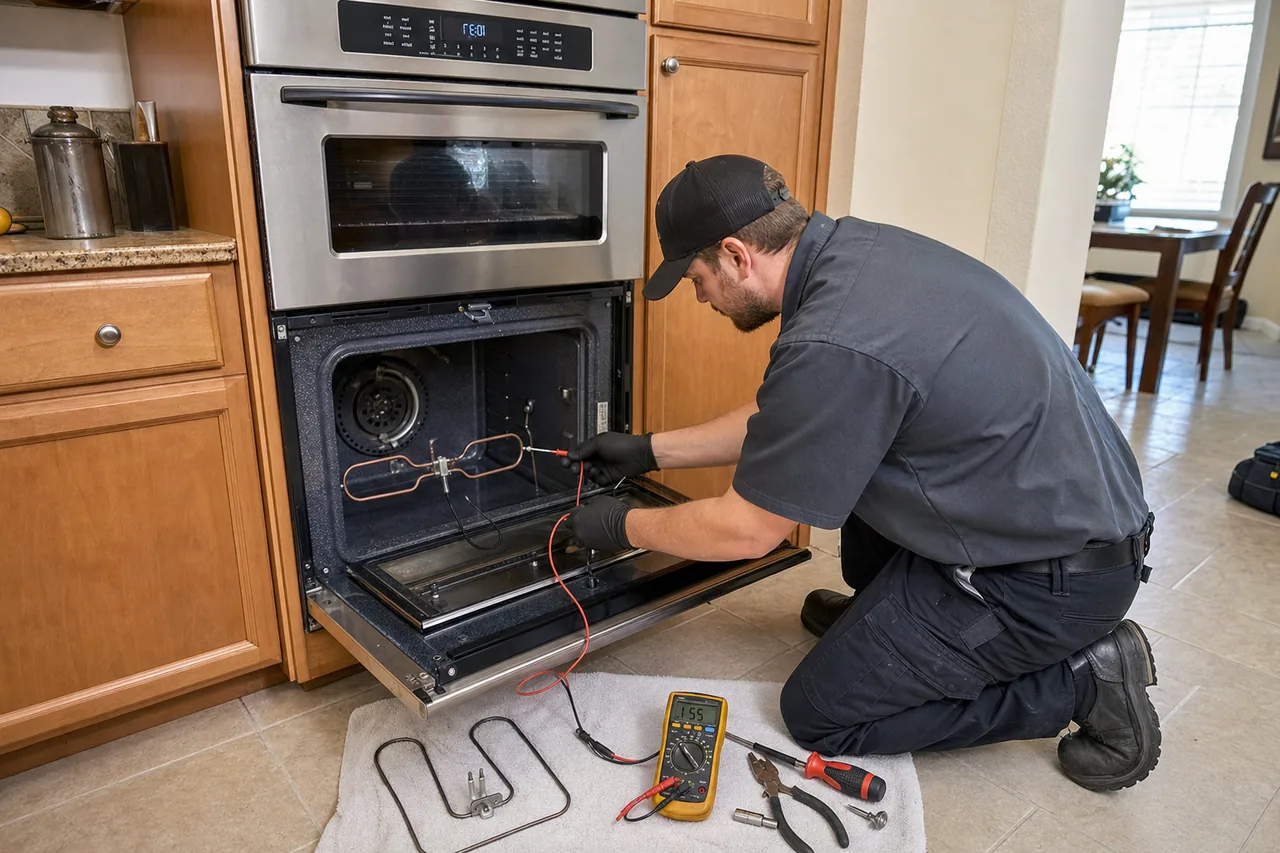
On most Bosch built-in wall ovens, the temperature sensor is the thin metal probe that sticks out from the back wall of the oven cavity, usually high up near one of the top corners, held by a small plate and screws. Its wire passes through the rear wall to a plug behind the cavity, and if the sensor has failed, a typical replacement runs $280–$450, with the firm quote given on site after diagnosis.
The electronics read the probe’s resistance, which rises as the cavity heats, and switch the elements on and off to hold the set point. When the probe or its wiring goes bad, the oven cooks at the wrong temperature or stops and shows a fault.
Where is the temperature sensor in a Bosch oven?
Take the racks out and shine a flashlight on the back wall. The sensor is a slender metal rod a few inches long with a small flat plate at its base. On convection models it often sits close to the round fan cover, so don’t confuse it with the fan cover’s screws.
- Double ovens have two sensors, one per cavity. Each oven is controlled separately, so a problem in one cavity points to that cavity’s sensor.
- The probe is only the visible half. The connector sits behind the rear wall. On some models a few inches of wire pull through the hole once the screws are out; on others the oven has to come out of the cabinet, a two-person job on a heavy built-in unit.
- Find the model number first. On 500 Series built-in ovens such as the HBL5451UC, the data plate is on the left side of the door trim on bottom-hinge ovens (the lower cavity on a double), and opposite the hinge on side-hinge single ovens. Sensors differ between models, so match the part to that number.
What are the signs that a Bosch oven sensor is failing?
Watch for baking that is consistently off in one direction, always pale or always dark, after you’ve ruled out pans and rack position. Other signs are a preheat signal while the oven is clearly still cool, an oven that runs much hotter than the setting, or results that swing widely from batch to batch.
The display can tell you too. An “E” followed by a number, with the control beeping, is how Bosch built-in ovens report an electronics fault. Press any button or turn any knob to stop the beeping, reset the oven if needed, and call for service. The sensor is one possible cause; wiring and the control board are others.
| Symptom | Likely cause | What the owner can check | When to call a technician |
|---|---|---|---|
| Food always too light or too dark | Sensor slightly off, or normal variation | Pans, rack position, then the offset | When the error is bigger than the offset can correct |
| Oven runs far hotter than the setting | Sensor, wiring or control board fault | A bent probe or loose mounting plate | Right away; stop using it |
| Preheat signal while the oven feels cool | Sensor reading high | A thermometer average over 20–30 minutes | If the average is far below the setting |
| Slow or uneven heat in a gas range oven | Weakening igniter | Whether the burner lights promptly | If ignition is delayed or you smell gas |
| ”E” plus a number, beeping | Electronics fault | Silence it and reset at the breaker | If the code comes back |
If you ever smell gas, turn the oven off, leave the house and call your gas utility from outside.
Can an oven thermometer tell you if the sensor is bad?
Only within limits. Bosch’s manual warns against judging its built-in ovens with a residential oven thermometer, because the temperature rises and falls throughout normal cooking, so one reading can look wrong when nothing is. Bosch’s advice is to set a temperature offset if food keeps coming out too brown or too light.
A thermometer still helps spot a large, steady error. Put it on the center rack, set bake to 350°F and wait about 20 minutes after the preheat signal. Then read it through the window every 5 minutes for 20–30 minutes and average the readings. An average that misses the setting by more than 35°F, the most the offset can correct, points to the sensor, the wiring or the control.
How do you calibrate a Bosch oven with the temperature offset?
Bosch built-in ovens let you shift the temperature anywhere from 0° to +/-35°F (0° to +/-19°C). The offset applies to bake, convection bake, roast, convection roast and convection multi-rack. It does not change self clean, broil, convection broil, warm or pizza, so it won’t fix broiling that seems off.
The menu path differs between models, so follow your Use and Care Manual. Work in small steps: if cookies keep coming out dark, lower the offset by about 10°F, bake the same recipe again and adjust from there. If you reach the 35°F limit and results still miss, the problem is a part, not a setting.
Can you replace a Bosch oven temperature sensor yourself?
Handy owners sometimes can, when the connector is reachable from inside the cavity. The job takes 4 steps:
- Turn the oven off at the circuit breaker and let the cavity cool completely.
- Remove the racks and the screws holding the sensor plate.
- Ease the probe forward and pull the wire gently until the connector appears. If it won’t come, the plug is behind the oven; stop there.
- Plug in a replacement that matches your model number, refit the screws and restore power.
A technician can also measure the old probe’s resistance against the specification for your model, which separates a bad sensor from a wiring or control fault before you buy a part. Check the warranty first, too: Bosch lists a 1-year limited warranty on the entire appliance, parts and labor, for its built-in wall ovens and ranges.
What does a Bosch oven sensor repair typically cost?
These are typical ranges; the firm quote is given on site after diagnosis:
- Diagnostic / service call: $95–$149
- Thermostat or temperature sensor: $280–$450
- Control board or electronics: $400–$850
See repair pricing for the full list. Purchase Wolf Appliance Repair is an independent service, not manufacturer-authorized, and works on Bosch ovens and ranges as well as Wolf cooking equipment; see our Bosch service page and wall oven repair. We cover Purchase, NY, plus Harrison, Rye Brook, West Harrison, Rye, Port Chester and White Plains. Call (475) 471-0742.
Frequently asked questions
Is there a reset for a Bosch oven temperature sensor?
No, the sensor itself has no reset; it either reads correctly or it doesn’t. Bosch’s manual describes a power reset for a door that stays locked after cooling: turn the oven off at the breaker, wait five minutes and turn it back on.
Is the oven thermostat the same thing as the temperature sensor?
On electronic Bosch ovens, effectively yes: the control board acts as the thermostat using the sensor’s readings. A “thermostat replacement” on these ovens means replacing the sensor or, less often, the control board.
Why won’t my Bosch oven start another self-clean right away?
That is normal. Bosch built-in ovens refuse a new self-clean cycle for 24 hours after one finishes, and on a double oven neither cavity can self-clean again in that window.